Chapter 21 · The Profession & the Future
The Business of Audio
“Nobody is going to protect your career for you. Not your manager, not your label, not your lawyer. You.”
—Asaf Fulks
By the end of this chapter, you will be able to:
- Distinguish the composition copyright (Form PA) from the master recording copyright (Form SR) and explain how each generates a distinct set of royalties
- Apply split sheets, work-for-hire agreements, and Section 203 termination rights as the three primary tools for protecting ownership of creative work
- Identify the five revenue streams in the music industry—performance, mechanical, sync, producer points, and streaming—and describe how PROs, the MLC, and SoundExchange collect each
- Decode the key terms of a recording contract—advances, royalty deductions, 360 deals, cross-collateralization, controlled-composition clauses, and the Letter of Direction—and evaluate how each term affects an artist's or producer's net income
- Compare full-transfer, co-publishing, and administration publishing deal structures and select the structure appropriate to a given career stage and negotiating position
- Explain sync licensing as a two-license transaction requiring both a sync license and a master use license, and apply the Bridgeport and VMG Salsoul standards to assess the risk of incorporating an uncleared sample
- Set up a three-stage audio business entity progression—LLC, S-Corp election, and loan-out corporation—and identify the non-negotiable paperwork practices that protect earnings at each stage
- Use Spotify for Artists and Apple Music for Artists to pitch unreleased tracks for editorial consideration, distinguish editorial from algorithmic playlists, and execute a pre-save campaign within the required pitch windows
A producer I worked with—talented guy, real ear for melody—came to me after a track he co-wrote blew up on streaming. Millions of plays. He had written the beat, the hook, and arranged the entire production. The artist released it, it charted, and when the money came in, the artist claimed full ownership. My guy had nothing in writing. No split sheet. No producer agreement. No email chain that even mentioned his name. Everything he contributed—every chord, every drum pattern, every late night in the studio—meant nothing without a piece of paper.
He asked me what he could do. I am a member of the California State Bar. I knew the answer, and he was not going to like it: almost nothing. Without documentation, you are begging. With documentation, you are negotiating.
That story is not rare. It happens every week in studios across the country. You can be the most talented engineer on the planet, but if you do not understand the business side of audio, you will get eaten alive. This chapter is not a suggestion. It is survival. I write it as someone who spent twenty years running a studio and as an attorney who has seen what happens when creative people ignore the paperwork.
A word of caution: this chapter provides general information to help you understand business and legal concepts in the audio industry. It is not legal advice. Consult with a qualified attorney for specific legal matters—especially before signing any contract.
Copyright: The Foundation of Everything
suggest a correction“If you don't own your masters, your master owns you.”
—Prince, Rolling Stone, 1996
Prince spent the 1990s appearing in public with the word “slave” written on his cheek to protest the ownership terms of his Warner Bros. contract. He was not being theatrical—he was telling the truth. The single most important sentence in this chapter: the moment you create an original work and fix it in a tangible medium, you own the copyright. Record a beat to your hard drive? Copyright. Write lyrics on a napkin? Copyright. Hum a melody into your phone's voice memo? Copyright. No registration required. No © symbol needed. No formalities whatsoever. That is Section 102 of the Copyright Act of 1976 (17 U.S.C.)—the foundation of the entire music industry.
But here is where it gets interesting—and where people lose money.
Every song involves two separate copyrights:
The Composition Copyright (the song itself) — covers the melody and lyrics, plus a sufficiently original arrangement, and is registered on Form PA (Performing Arts). (Bare chord progressions and generic song structures are not protectable—courts treat them as common musical vocabulary.) Think of it as the recipe. This generates performance royalties (radio, streaming, live), mechanical royalties (reproduction), and sync royalties (film, TV, ads).
The Master Recording Copyright (the actual recording) — covers the specific recorded version of the song and is registered on Form SR (Sound Recording). Think of it as the finished dish made from that recipe. This generates streaming revenue, download sales, and master-use sync fees.
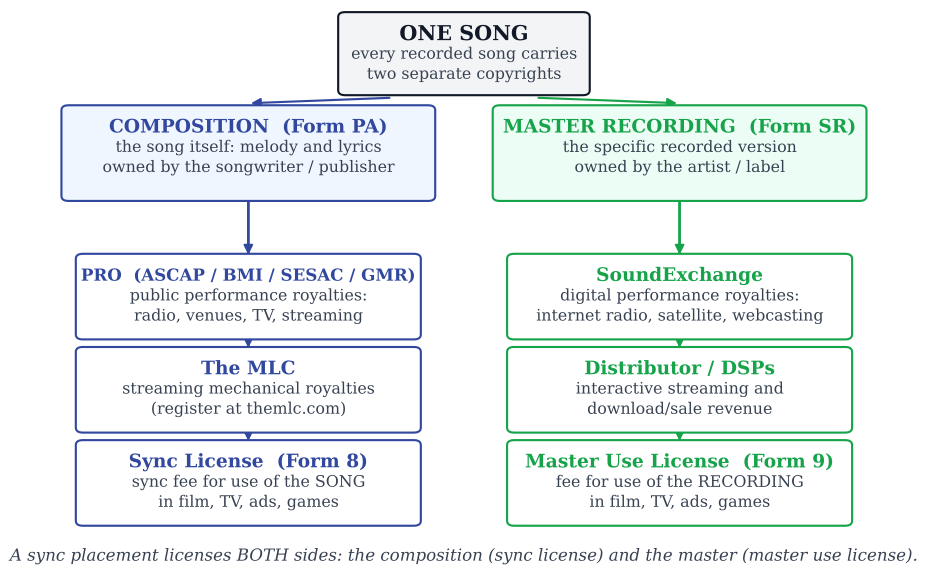
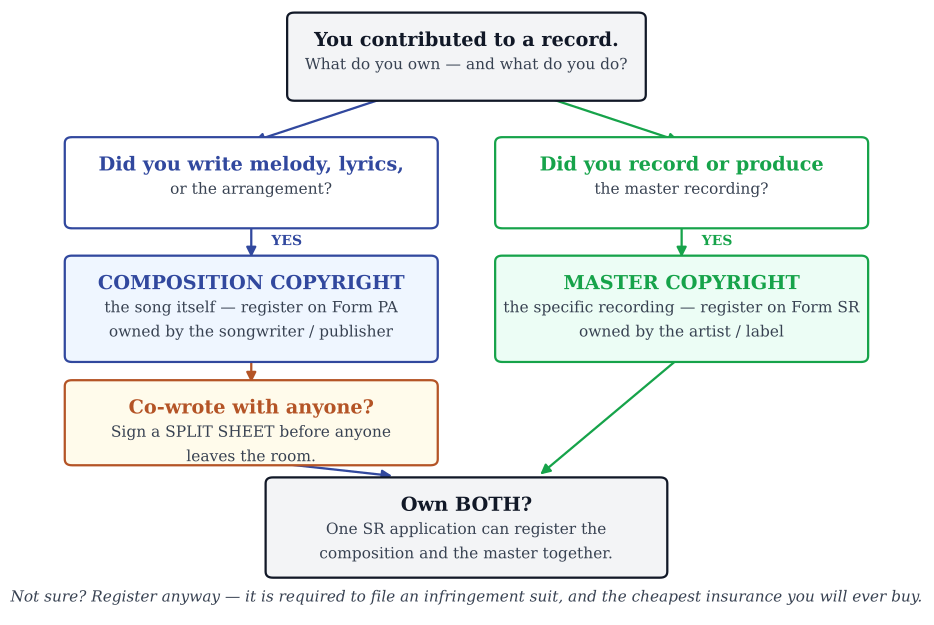
Why does this matter to you personally? Because as a producer or engineer, you may contribute to one or both. If you wrote the chord progression and melody, you have a claim to the composition. If you recorded and mixed the track, you contributed to the master. Understanding which copyright you are contributing to—and negotiating accordingly—is the difference between getting paid and getting a “thanks bro” text.
Section 106 of the Copyright Act spells out the exclusive rights you hold as a copyright owner: reproduction, distribution, public performance, public display, the preparation of derivative works (17 U.S.C.), and—for sound recordings—public performance by digital audio transmission. Every dollar in the music business traces back to one of these rights. Mechanical royalties flow from the reproduction right. Performance royalties flow from the public performance right. Sync fees flow from the reproduction right (the music is copied in timed relation to the picture), with the public performance right also in play when the finished film or show is exhibited. When you understand Section 106, you understand where every revenue stream in this industry comes from.
Now—registering your copyright with the U.S. Copyright Office is not required for copyright to exist, but it is required if you ever need to enforce it. Registration costs $65 for the standard application ($45 for a single-author, single-work filing where you are the sole claimant), and it gives you the ability to sue for statutory damages and attorney's fees. Without it, you can only recover actual damages—which in many cases means proving exactly how much money you lost, which is expensive and difficult. Register your work. It is the cheapest insurance you will ever buy. And here is a practical tip that saves you time and money: if you own both the composition and the recording—which is increasingly common for independent producers—you can register both in a single application using the SR (Sound Recording) form with the Copyright Office. One filing, one fee, both copyrights protected.
Work for Hire: The Trap You Need to Understand
suggest a correctionA session musician walks into my studio, plays a killer guitar part on a track, gets paid $500, and goes home. Who owns that guitar part? If he signed a work-for-hire agreement—and he almost certainly did—the answer is: not him. Not now, not ever.
A work-for-hire agreement means the person or entity that commissioned the work is considered the legal author and copyright owner from the moment of creation. You are not transferring your rights. Legally, you never had them. Under U.S. copyright law, work for hire applies in two situations: (1) work created by an employee within the scope of employment, or (2) work created by an independent contractor under a written agreement that explicitly states the work is “made for hire” and falls within one of nine statutory categories listed in Section 101.
Here is something most people in the industry do not know: a standalone sound recording is not on that list of nine categories. This means a sound recording created by an independent contractor cannot technically be a true “work made for hire” under the statute—even if the contract says it is—unless it qualifies as a “contribution to a collective work” or “part of a motion picture or other audiovisual work.” That exclusion comes from the statute itself—the nine § 101 categories—not from any single case. (The Supreme Court's Community for Creative Non-Violence v. Reid (1989) governs the separate, threshold question of who counts as an employee versus an independent contractor in the first place.)
The practical implication? Many studio contracts include work-for-hire clauses that may not be legally enforceable for standalone recordings by independent contractors. If a court finds the clause unenforceable as work-for-hire, the agreement functions as a copyright assignment instead. And that distinction matters enormously, because of what comes next.
Section 203: Your Escape Hatch
suggest a correction“For years I asked, pleaded for a chance to own my work. Instead I was given an opportunity to sign back up to Big Machine Records and ‘earn' one album back at a time, one for every new one I turned in… You deserve to own the art you make.”
—Taylor Swift, open letter, June 30, 2019
Taylor Swift spent roughly six years fighting to own her work—re-recording and releasing four of her first six albums as the famous “Taylor's Version” projects to dilute the value of the masters she did not own—before buying those masters outright from Shamrock Capital in 2025, reportedly for several hundred million dollars. (Terms were not officially disclosed; the figure is as reported in the trade press.) She described the moment she finally bought them all back as the fulfillment of her greatest dream. Most creators will never have her resources, but every creator has access to a quieter version of the same protection: Section 203.
This is the provision in copyright law that most creators do not know exists, and it might be the most powerful protection you have.
Section 203 of the Copyright Act says that any transfer of copyright ownership—other than a true work for hire—can be terminated by the author during a five-year window beginning 35 years after the transfer. This right is inalienable. You cannot waive it. You cannot contract it away. Even if the contract explicitly says “this transfer is irrevocable and permanent,” Section 203 overrides it.
Read that again. If you assigned your copyright in a song or recording, you or your heirs can reclaim it after 35 years. Major artists and estates have used this to recover catalogs worth millions. And remember what we just discussed about work-for-hire clauses that may not hold up in court? If a work-for-hire clause is reinterpreted as an assignment, Section 203 kicks in—meaning rights you thought you gave up permanently might come back to you.
The termination must be exercised by serving written notice on the grantee no less than two and no more than ten years before the effective date you choose—which means the earliest you can serve notice is 25 years after the grant—and the filing requirements are exacting enough that you want a lawyer on it well before the window opens. But the principle is simple: the law does not let you permanently give away your creative work unless you were truly an employee. That is Congress protecting creators from their own bad deals.
Split Sheets: The Most Important Piece of Paper in the Studio
suggest a correctionI cannot stress this enough: complete a split sheet before anyone leaves the session.
A split sheet is a document signed by every person who contributed to the composition—every songwriter, every producer who added creative elements—that defines each person's percentage ownership. It does not need to be fancy. It can be one page. It just needs names, percentages, PRO affiliations, publisher information, and signatures.
The reason this gets its own section is because failing to create split sheets is the single most common and most costly mistake in the music industry. I have seen it destroy friendships, end partnerships, and leave talented people with nothing. When a song blows up six months after the session, memories get creative. The artist remembers writing the whole hook. The producer remembers suggesting the chord change that made it work. Without a split sheet, these disputes become a he-said-she-said nightmare that only lawyers win.
Here is the five-step split-sheet process I run on every session that has more than one creative contributor:
- Print the split sheet template (or pull it up on a phone—Appendix B has one). Names, percentages, PRO affiliations, publisher info, signatures.
- Talk through the contributions while everyone is still in the room. Who wrote the melody? Who wrote the lyrics? Who added the chord change that made it work? Who is producing? Get everyone to agree out loud first.
- Negotiate the percentages. The arithmetic must total 100%. The default in collaborative songwriting is equal splits among contributors, but contribution rarely splits perfectly evenly. Talk it through.
- Sign and date. Every contributor signs. Take a photo of the signed sheet on every phone in the room. Email it to everyone before they leave.
- File the original in your studio's project folder, scan it to cloud storage, and keep a copy as part of your session deliverables.
Do it in the room. Do it before anyone leaves. A five-minute conversation at the end of a session can save you five years of litigation.
Contracts: What You Need to Know Before You Sign
suggest a correction“The biggest mistakes [young artists] tend to make is getting tied up in long-term agreements with managers, record companies and producers, without any ability to get out of their contracts if those people fail to help the artist achieve success.” —Donald Passman, in a SongwriterUniverse interview, on his book All You Need to Know About the Music Business (industry bible since 1991)
Don Passman has been the music attorney for Taylor Swift, Paul Simon, Stevie Wonder, and Adele. He wrote the book they all read. His advice on getting out of bad contracts: stipulate exit clauses tied to performance milestones (a label that fails to deliver promised marketing or sales activates your right to leave). Most reputable industry pros will accept these clauses; the ones who refuse are the ones you should walk away from.
Every professional audio relationship should be governed by a written agreement. I know—contracts are not why you got into music. But the alternative is trusting that everyone will do the right thing when money is involved, and I can tell you from twenty years of experience: they will not.
Recording Contracts
The traditional recording contract between an artist and a major label is one of the most complex agreements in entertainment law. Even if you are a producer or engineer, understanding these deals helps you understand what your clients are navigating.
The Advance — is not free money—it is a recoupable loan deducted from the artist's future royalties. Until the advance is fully recouped, the artist receives no royalty payments. The critical question is not the size of the advance but the royalty rate, recoupment structure, and deductions that follow it.
Royalty Rates — for recording artists typically range from 12% to 20% of the suggested retail price. But the contract specifies numerous deductions—packaging deductions (typically 25% for CDs), free goods provisions, reserve provisions, and new technology deductions. After all deductions, a nominal 15% royalty can effectively become 8% or less. The label is not hiding this. It is in the contract. Most artists just do not read it.
360 Deals — have become the standard at major labels. The label participates not only in recording revenue but also in touring, merchandise, endorsements, and publishing—typically 10% to 30% of non-recording revenue. If you are advising an artist: push for lower percentages, higher thresholds before participation kicks in, sunset provisions, and exclusions for revenue the label does not actively support.
Option Periods — give the label the right to extend the contract for additional albums. A typical “1 firm + 4 options” structure means one committed album with four optional extensions. The artist cannot leave; the label can drop them at any option point. Negotiate for the fewest possible options and escalating advances.
Key Person Clauses — allow the artist to exit if a specific champion at the label departs. Without this, an artist can be stuck at a label where nobody cares about their project. I have seen it happen. It is career death in slow motion.
Controlled Composition Clauses — cap the mechanical royalty the label pays the artist for songs the artist wrote—historically at 75% of the statutory rate. This effectively reduces the artist's mechanical income by 25% or more. Resist these whenever possible.
Most-Favored-Nations (MFN) Clauses — guarantee that you will receive terms no worse than any other person in the same role on the project. If the label gives another producer on the album higher points, your points are matched up automatically. Standard request on hit-track producer deals; under-negotiated by inexperienced creators.
Audit Rights — let you (or your accountant) inspect the label's books to verify your royalty statements. Every recording and publishing contract worth signing has an audit clause. The standard scope: the right to audit each statement once, within a window (typically 2–3 years), at your expense unless the audit discloses underpayment beyond a threshold (typically 5–10%), in which case the label pays your audit costs. Without audit rights you are trusting the label's accounting department—and royalty disputes are the single largest source of recovered income in entertainment litigation.
Cross-Collateralization — is the label's most useful trick: revenues from one project can be used to recoup unrecouped balances on another. If your first album recouped its advance and your second did not, the label can use your first album's royalties to recover the second album's deficit before paying you anything. Negotiate against this where possible—demand each album be its own recoupment silo, especially for option albums that the label chose to make.
Producer Agreements
Points — are your royalty—typically 2 to 5 percentage points of the master recording revenue. Make sure they are “retroactive to record one”: once recording costs recoup, you are paid on every record sold from the very first unit—not only on units sold after the recoupment point. The difference can be tens of thousands of dollars.
The Letter of Direction (LOD) — instructs the record label to pay your royalty share directly to you, bypassing the artist. Without an LOD, you are relying on the artist to forward your payments. Get the LOD. Always.
Credit — has career value beyond money. Negotiate “Produced by [Name]” on the recording, in liner notes, in digital metadata, and in marketing materials. In the streaming era, metadata is everything—if your producer credit is not in the metadata, it effectively does not exist.
Publishing Deals
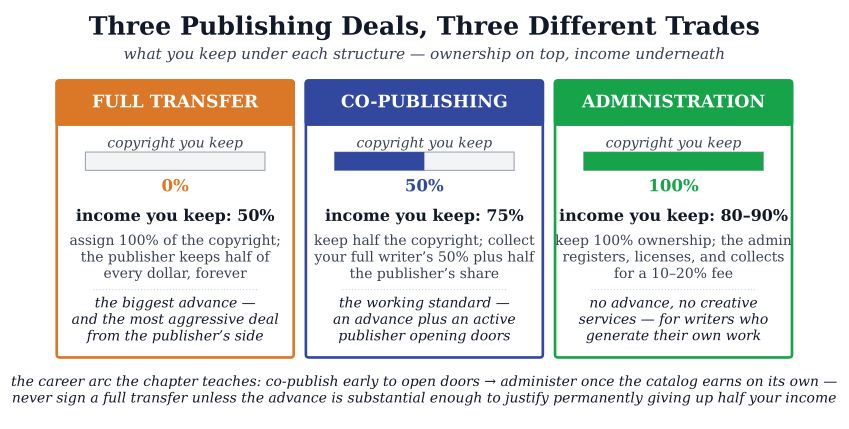
Publishing deals come in three basic structures, and the economics are fundamentally different:
Full Publishing Transfer: — you assign 100% of the copyright to the publisher. You receive 50% of all income (the “writer's share”) while the publisher keeps 50%. This is the most aggressive deal from the publisher's side.
Co-Publishing Deal: — the most common structure for established writers. You retain 50% of the copyright and assign 50%. You receive your full writer's share (50%) plus half the publisher's share (25%)—totaling 75% of all publishing income.
Administration Deal: — you retain 100% ownership. The administrator handles registrations, licensing, and collection for a fee of 10% to 20% of gross income. No advance, no creative services. Best for writers who generate their own opportunities.
The strategic calculation: early in your career, a co-publishing deal with an active publisher can open doors. As you build a catalog, an administration deal preserves ownership. Never sign a full transfer unless the advance is substantial enough to justify permanently giving up half your income. The chart below puts the three structures side by side.
California Talent Agencies Act: Manager vs. Agent
If you work in California (or for any California-based artist), there is a statute that gets entertainment attorneys called every week and almost no music textbook explains: the California Talent Agencies Act (Cal. Labor Code §§ 1700–1700.47).
The Act says that only a state-licensed talent agent can “procure employment” for an artist—in other words, only a licensed agent can legally solicit, negotiate, or accept employment on an artist's behalf. One major exception: under Labor Code § 1700.4, procuring a recording contract is carved out—a manager or attorney may secure a record deal without an agent's license. Managers are not licensed under the Act and technically cannot procure employment in California, even though in practice many managers do. When a manager negotiates a deal in California without a license, the artist can petition the California Labor Commissioner, which may void the procurement-tainted commissions and order repayment of money the manager collected through that unlawful procurement. The Commissioner once routinely voided entire management contracts, but the California Supreme Court curtailed that in Marathon Entertainment v. Blasi (42 Cal. 4th 974 (2008)), the leading case: under the doctrine of severability, only the procurement-tainted provisions fall away, so a manager may still recover commissions on services that did not involve unlawful procurement. The remedy is real, but it reaches the tainted commissions, not automatically the entire deal.
Practical implications: in California, agents handle procurement (and take 10% commission, capped by union scale where applicable). Managers handle career strategy, day-to-day decisions, image, opportunities the artist brings to them (typically 15–20% commission). Lawyers handle contracts. Business managers handle finances. Each has a defined role; the lines blur in practice; the Act keeps the lines from collapsing entirely. Working in entertainment without understanding this structure is how artists end up in disputes that cost them their careers.
The full advisor team, in one view:
| Advisor | Typical cost | What they do / when to hire |
|---|---|---|
| Personal manager | 15–20% of gross | Career strategy and day-to-day; hire when there is a career to manage, not before |
| Booking agent | 10% of live income | Procures shows (the licensed role under the TAA); hire when demand outgrows your inbox |
| Attorney | Hourly, or ~5%, or value billing | Contracts and deal-making; hire before signing anything significant |
| Business manager | ~5% of gross (or flat/hourly) | Accounting, taxes, tour finances; hire when the money gets complicated |
| Publicist | Monthly retainer | Press and profile, usually campaign-by-campaign around releases and tours |
Two rules keep the table honest. Add advisors when the work exists, not as status—every percentage above comes out of the same gross, and a fully staffed team can consume a third of it. And never let one person hold two seats: the manager who is also the business manager has no one checking the math.
Music Distribution
suggest a correctionBefore money, distribution. The music distribution landscape has shifted dramatically. Physical media (CDs, vinyl) accounted for the majority of revenue as recently as 2010; streaming generates approximately 69% of recorded music revenue worldwide (IFPI, 2025). Services like Spotify, Apple Music, YouTube Music, Tidal and Amazon Music allow listeners instant access to tens of millions of tracks. For engineers, this means understanding the delivery specifications of each platform: most streaming services accept high-resolution WAV or FLAC masters and then encode to their own distribution format.
Although physical media sales have declined, CDs remain part of the distribution landscape. CDs are manufactured using two methods: replication and duplication. Replication involves creating a glass master disc from which a metal stamper presses copies—these are the silver-bottomed discs sold commercially. Duplication uses a laser to burn data onto recordable discs, leaving a visible ring where the laser wrote. Replication is used for large commercial runs; duplication is used for smaller quantities and short-run releases.
Digital audio has been a double-edged sword for musicians. On one hand, it has made the creation and distribution of music dramatically easier and more affordable. On the other, the low barriers to entry have saturated the market with content, and streaming royalty rates remain a subject of intense debate—which is exactly the topic of the next section.
Discovery and the Artist Platforms
A client of mine released her third single through DistroKid, hit publish, and then sat back and waited. Six weeks later she called me confused: “Why is nobody finding it?” Getting your master onto the platforms is the floor, not the ceiling. The ceiling is discovery—and the platforms have given artists tools to influence it, if you know where to look.
Spotify for Artists (artists.spotify.com) and Apple Music for Artists (artists.apple.com) are the artist-facing dashboards for the two largest paid streaming services. Both provide stream counts, listener geography, playlist adds, and audience demographics. Think of them as the analytics layer sitting on top of your distributor's payout reports: where your distributor tells you what you earned, these dashboards tell you why.
Editorial Playlists — playlists curated by humans on the platform's editorial staff. On Spotify, titles like New Music Friday, RapCaviar, and Fresh Finds are editorial. A single editorial add can move a track from hundreds of streams per day to hundreds of thousands. On Apple Music, New in Hip-Hop, A-List Pop, and the flagship New Music Daily operate the same way—human curators, high visibility, life-changing for an independent artist.
How to pitch Spotify editorial playlists. Log into Spotify for Artists, navigate to your upcoming release, and submit a pitch before the track goes live—you cannot pitch a song after it releases. The minimum lead time is seven days before release date; submissions made fourteen or more days out see roughly twice the editorial consideration rate compared to the seven-day minimum. Your pitch includes genre, mood, instruments, and a short description of the release context. Spotify's editorial team reads these. Be specific and honest: “indie bedroom-pop, fingerpicked acoustic guitar, themes of insomnia and anxiety” is useful; “a genre-blending masterpiece” is noise.
One hard rule: you can pitch only one song per release, and only unreleased tracks are eligible. Pick the track that best represents the project, not necessarily the lead single—sometimes an album cut is a better fit for a specific playlist's mood.
The Release Radar guarantee. If you submit your pitch at least seven days before release, Spotify will automatically add the track to the Release Radar playlists of everyone who follows you or has streamed you recently. Release Radar is a personalized weekly playlist, refreshed every Friday, that surfaces new music from artists each listener already has some connection to. This is the floor: editorial consideration is a lottery, but Release Radar delivery to your existing audience is guaranteed if you hit the seven-day window.
How to pitch Apple Music editorial. From the Promote section of Apple Music for Artists, use the Apple Music Pitch tool. Submit at least ten days before release for full consideration; seven days is the late-add deadline. Tracks with Spatial Audio, synced lyrics, and motion artwork receive priority consideration from the editorial team. Apple's process is human-curated and distributor-agnostic: independent artists with iTunes Connect access (which your DistroKid, TuneCore, or CD Baby account provides) can pitch directly.
Algorithmic Playlists — playlists generated entirely by machine learning, personalized per listener. On Spotify, the two you most want to understand are Discover Weekly (refreshed every Monday, introduces listeners to music they have not heard) and Release Radar (Friday, new releases from known artists). You cannot pitch these; the algorithm decides. Spotify's system weights save rate and repeat-listen ratio heavily—a listener who saves your track or plays it back-to-back signals engagement far more powerfully than a passive stream. Playlists a listener adds your track to, and a low skip rate in the first thirty seconds, also feed the model. Early engagement from a real audience matters more than raw stream volume.
User Playlists — playlists assembled by individual listeners and sometimes by editorial channels at independent blogs or playlist-submission platforms. Placement on a user playlist with 50,000 followers can outperform some mid-tier editorial placements. Services like SubmitHub allow artists to pay small fees to pitch blogs and playlist curators directly—legitimate when used honestly, a money pit when used as a substitute for making a good record.
Pre-save campaigns. A pre-save link lets fans authorize Spotify or Apple Music to automatically add your release to their library the moment it goes live. Spotify's native tool is Countdown Pages, launched broadly in July 2024: create one inside Spotify for Artists, and it surfaces on your artist profile, in Search, and in Spotify's Upcoming Releases hub. Fans who pre-save get a push notification on release day. Pre-saves convert to day-one saves, and day-one saves spike the engagement metrics that feed the algorithmic playlists. Artists who publish a Countdown Page at least seven days before release average nearly twice as many pre-saves as those who publish later.
For Apple Music, the equivalent is a pre-add, typically set up through third-party smart-link tools such as Feature.fm or Linkfire that generate a single landing page covering both platforms. Collect email addresses at the same time—every fan who pre-saves is giving you permission to contact them directly, which has long-term value far beyond any single release.
The release pipeline, in order: finish the master, deliver to your distributor at least four weeks out, pitch Spotify for Artists and Apple Music for Artists within 48 hours of distribution acceptance, launch your Countdown Page, and drive traffic to the pre-save link through every channel you have. That sequencing—not luck—is what creates a clean release.
Money: Where It Comes From and How to Collect It
suggest a correctionYou need to understand where every dollar in this industry originates, because nobody is going to chase down your money for you.
Engineer Income vs. Producer Income
These are fundamentally different careers wearing the same studio clothes, and treating them as the same thing is why engineers end up wondering how their producer friends bought a house.
The engineer typically works for a flat fee—per session, per song, per project, per day. Cleanly tracked, cleanly billed, taxes withheld if employed by a studio or 1099'd if freelance. The work is steady when the calendar is full and zero when it is empty. Engineers rarely earn royalties on the records they cut; the work is almost always work-for-hire on the master recording. The upside: predictability and capped exposure (you do not bet on a record). The downside: capped earnings (you cannot 10x because the song goes platinum). Most working engineers I know diversify into mixing-for-hire (better day rate), teaching, gear reviews, plugin endorsements, or running their own studios.
The producer is in a different financial weather system entirely. Producers typically take points (2–5% of master royalties), sometimes an upfront fee, often a publishing share if they wrote part of the composition. The work is boom-and-bust: a producer may earn $0 from a session for 18 months, then a single placement earns $200,000 in mechanicals and sync. The hits pay for the misses. Producers who do not negotiate publishing on songs they wrote for, or fail to get an LOD on the master royalty, leave most of their actual income on the table. Most producers I know also engineer to keep the lights on between hits.
Know which career you are running. The paperwork, the negotiation, the royalty registration are different. The engineers I have watched survive twenty years did so by being world-class at the work and ruthless about getting paid for the work they did. The producers who survived twenty years did so by chasing points and publishing aggressively.
The Five Revenue Streams
Performance Royalties: — paid when a song is performed publicly—radio, streaming, live venues, TV. Collected by PROs (Performing Rights Organizations) like ASCAP, BMI, and SESAC—plus the invitation-only Global Music Rights (GMR), a fourth U.S. PRO worth checking a co-writer's affiliation against, even though you cannot simply apply to join it. Register with a PRO as both a songwriter and a publisher. If you only register as a songwriter, you are leaving the publisher's share on the table.
Mechanical Royalties: — paid when a song is reproduced—physical copies, downloads, and interactive streams. The current statutory rate is 13.1 cents per song for physical and downloads (2026 rate, adjusted annually for inflation). Streaming mechanicals are calculated differently—the Music Modernization Act sets a percentage of streaming-service revenue (15.3% for 2026, phasing up to 15.35% in 2027 under the Phonorecords IV schedule) that flows into a mechanical royalty pool, which is then distributed pro-rata to publishers and songwriters based on each track's share of total streams. The MLC handles this distribution (Music Modernization Act of 2018). Whether you earn from the pool depends on whether your works are registered.
Sync Fees: — one-time payments for the right to use a song with visual media. These can range from a few hundred dollars for an indie film to hundreds of thousands for a major commercial. We will cover this in depth in the next section.
Producer Royalties (Points): — typically 2–5% of retail or wholesale revenue from the master, paid after the label recoups its investment.
Streaming Revenue: — fractions of a cent per play. Current approximate rates: Spotify $0.003–$0.005, Apple Music $0.007–$0.01, Tidal $0.008–$0.012, YouTube Music $0.002–$0.005.
Let me put that in perspective. At an average rate of $0.004 per stream, (Per-stream payouts are estimates and vary widely by service, listener territory, and subscription tier; Spotify reports current figures in its annual Loud & Clear summary.) you need 250,000 streams to earn $1,000 before distributor cuts. One million streams—a milestone that feels massive—generates approximately $4,000 gross. That is not a living. That is a few months of car payments.
The economic reality: streaming alone cannot sustain most artists or producers. The people who build sustainable careers stack multiple revenue streams—sync placements, production fees, mixing fees, session work, teaching, and licensing. Diversify early. Diversify aggressively.
The Live Business: Touring Deals
Recorded music is no longer where most artists earn most of their money—the stage is. The deal structures are worth knowing even if you never tour, because engineers get hired into this world (Chapter 20's live recording and timecode work) and producers increasingly share in it. A show deal takes one of three basic shapes. A flat guarantee: the promoter pays a fixed fee regardless of ticket sales—all the risk on the promoter, all the upside capped for the artist. A door split: the artist takes a percentage of ticket revenue—all risk, all upside. And the structure used for most professional shows, the guarantee plus backend: a guaranteed fee, plus a large share (commonly 85%) of the net box-office receipts after the promoter recovers documented show expenses and a defined profit—the crossover where the backend kicks in is called the split point. A common variant is the versus deal: a guarantee versus a percentage of the gross, whichever is greater. Two practical realities follow. First, “net after expenses” is only as honest as the expense accounting—which is why tours hold settlement meetings the night of the show, receipts on the table. Second, everyone's commission comes out of this money: the booking agent's 10% and the manager's 15–20% (the Talent Agencies Act section above) are calculated on revenue the artist may partly owe to the bus company. Touring grosses are not touring income.
Merchandise
Merch is the highest-margin item in the building—a shirt costs a few dollars to make and sells for thirty—which is why everyone wants a piece of it. An artist with leverage signs a merchandising deal: a merch company pays an advance for the right to manufacture and sell tour and retail merchandise, recouped against the artist's negotiated royalty on sales. Independent artists keep it in-house and keep the margin. Either way, the venue takes its cut: the hall fee, commonly somewhere between 10% and 30% of gross merch sales, charged for the privilege of selling inside the building—a number that became a public fight as artists pushed back and some venue chains waived fees for developing acts. Negotiate the hall fee before the show, get it in writing, and count inventory in and out every night; merch accounting is exactly as honest as its paper trail. For a developing artist, merch is often the difference between a tour that loses money and one that breaks even—treat it as a business line, not a souvenir table.
A word on NFTs. The 2021–22 boom in music NFTs—unique blockchain tokens sold as collectibles, sometimes bundled with perks or royalty shares—crashed hard, and most music NFTs are worth a fraction of their mint price. The sober residue: a small, real market for superfan collectibles and token-gated community access, and a set of cautionary tales about projects that promised royalty participation they could not legally deliver (a token granting a share of sound-recording revenue is, functionally, a security—with everything that word triggers). If an NFT pitch crosses your desk, the questions are the same ones this chapter has been teaching: what rights are actually being transferred, who owns the underlying work, and what happens when the platform hosting the token disappears.
The catalog gold rush. The biggest financial story in music since 2020 is not streaming—it is the multibillion-dollar global market for catalog acquisitions. Bob Dylan sold his songwriting catalog to Universal Music Publishing in 2020 for a reported $300–$400 million. Bruce Springsteen sold his recorded and publishing catalogs to Sony in 2021 for an estimated $500 million. Justin Bieber sold his catalog to Hipgnosis in 2023 for $200 million. Hipgnosis Songs Fund, Primary Wave, Concord, BMG, and the major labels are all aggressively buying catalogs as predictable streaming-revenue annuities. The lesson for working creators: the masters and publishing rights you control today may be worth multiples of their current annual revenue when you eventually decide to sell. Owning matters. Section 203 termination rights become catalog-acquisition negotiation leverage in twenty or thirty years. Build the asset; do not just collect the income.
Registration and Filing Quick Reference
Every revenue stream above only flows if you have registered correctly with the right collecting body. Below is the working musician's filing checklist—spend a Saturday afternoon doing all of these and your back-end starts working for you instead of for someone else:
| Registration | What It Protects/Collects | Cost | Where |
|---|---|---|---|
| U.S. Copyright Office (PA + SR) | Composition + Master rights; lets you sue for statutory damages | $65 per work | copyright.gov |
| PRO (ASCAP / BMI open; SESAC & GMR by invitation) | Performance royalties (radio, streaming, live, TV) | $0–$50 join (ASCAP/BMI) | ascap.com / bmi.com / sesac.com |
| MLC (Mechanical Licensing Collective) | Streaming mechanical royalties for compositions | Free | themlc.com |
| SoundExchange | Digital performance royalties for sound recordings (satellite radio, webcasting) | Free | soundexchange.com |
| USPTO Trademark | Artist/studio name protection nationwide | $350 per class | uspto.gov |
| ISRC codes | Track-level identification for streaming/distribution | Free via distributor | usisrc.org |
| ISWC codes | Composition-level identification | Free via PRO | via ASCAP/BMI/SESAC |
The MLC (Mechanical Licensing Collective): Created by the Music Modernization Act of 2018, the MLC is the central clearinghouse for streaming mechanical royalties. If your compositions are not registered at themlc.com, your mechanical royalties accumulate in a pool of unmatched money that eventually gets distributed to the biggest publishers based on market share. Your money goes to someone else. Register.
SoundExchange: Collects digital performance royalties for sound recordings—internet radio, satellite radio, webcasting. If you are a featured artist, session musician, or rights owner on a recording, register. This is money most people do not even know they are owed. Outside the U.S., jurisdiction-specific bodies handle collection—PPL and PRS in the UK, SOCAN in Canada—and international royalties flow back to you through reciprocal agreements with your U.S. PRO or via your distributor, but only if you are registered.
Sync Licensing: The Real Money
suggest a correctionIf there is one revenue stream that can change your financial life overnight, it is sync licensing. A single placement in a TV show, commercial, or film can generate more income than years of streaming royalties. I have seen unknown artists earn more from one car commercial than from their entire streaming catalog.
When a song is placed in visual media, two separate licenses are required:
The Synchronization (Sync) License: — grants permission to use the underlying composition—melody, lyrics, arrangement—in sync with visual media. Negotiated with the songwriter or their publisher. Fees vary enormously: a background placement in a web series might pay $500 to $2,000. A featured placement in a major film or national commercial can command $50,000 to $500,000. Super Bowl spots have hit seven figures.
The Master Use License: — grants permission to use the specific recording. Negotiated with the label or master owner. The fee typically matches or approximates the sync fee.
Both licenses must be secured before the song can be used. Here is why this matters to you: if you control both the composition and the master—which is increasingly common for independent producers and artists—you are in an incredibly powerful position. A single negotiation covers both rights. This is one of the strongest arguments for owning your masters and your publishing.
Build relationships with music supervisors. Submit to sync libraries. And critically: make sure your metadata is clean and complete. A music supervisor cannot license a song if they cannot figure out who owns it.
Scoring for Film and TV: The Business Side
Composing for picture is its own business, adjacent to sync but structured differently—sync licenses an existing song; a composer is hired to write. Most television scoring and much independent film runs on the package deal: the composer receives one all-in fee covering both their creative fee and the recording costs—musicians, studio time, mixing, orchestration—and keeps whatever is left. Bring the score in efficiently and the package rewards you; go over budget and the overage comes out of your pocket. (Larger theatrical features more often pay a creative fee with the production covering recording costs separately.) Almost all of it is work for hire—the production owns the score outright, with everything this chapter's work-for-hire section warned about—so the composer's long money is the backend: as the credited writer, the composer collects performance royalties through their PRO every time the work airs on television or streams, which is why a composer with a long-running series in syndication earns for decades. One structural quirk to know: in the United States, theatrical exhibition pays no performance royalties—movie theaters are exempt—so a film score earns its performance money from TV, streaming, and foreign theatrical, where overseas societies do collect for cinemas. The negotiation points are the fee, the package's cost responsibilities, the credit (main title versus end crawl matters for your next job), and—if you have the leverage—a share of the publishing on themes.
Short-Form Video: TikTok, Reels, and UGC Licensing
When your song plays under a TikTok or an Instagram Reel, that is technically a sync use—audio synchronized to picture. But nobody negotiates it per video. The platforms sign blanket licenses with labels, publishers, and distributors that cover their users' videos wholesale. Your way in is your distributor: when DistroKid, TuneCore, or CD Baby delivers a release, it lands in the platforms' music libraries, creators pull it from there, and the platform pays rights holders out of the blanket deal—recent independent-catalog deals calculate the split from the views that videos using your song accumulate, not the number of videos made. The direct money is small and the accounting is opaque; treat it as found money, not a revenue plan.
Three boundaries matter legally. First, the user license stops where commerce starts. A fan's video is covered by the platform's blanket deal; a brand using the same song in an ad—or putting paid spend behind a post—is not. Commercial use needs a real sync license, which is why TikTok maintains a separate pre-cleared Commercial Music Library for business accounts and walls the general library off from them. Second, user-generated content (UGC) is its own category: when someone uploads a video with your music already baked in, instead of picking the track from the library, the platform's content-identification system flags it, and whether you collect on those videos depends on your distributor's social-platform opt-in. Third—and this is the same metadata sermon as above—the matching engine pays whoever the ISRC points at. A typo in a title or artist name quietly unroutes your money.
The real business value of short-form video is not the royalty check; it is the funnel. A fifteen-second hook that trends drives streams on the platforms that do pay per play, sells tickets, and fills sync inboxes—which is why so many 2020s records put the hook inside the first chorus bar and keep a clip-ready section in mind from the writing stage. You do not have to like that; you do have to know it. Distribute everywhere from day one, opt in to the social platforms through your distributor, and read the usage lines on your statements.
Sampling: Creative Cornerstone, Legal Minefield
suggest a correctionSampling—incorporating a portion of an existing recording into a new work—is foundational to hip-hop, electronic music, and modern pop. It is also one of the fastest ways to end up in court.
The legal standard was set by Bridgeport Music, Inc. v. Dimension Films (6th Cir. 2005). The court's ruling was blunt: there is no de minimis exception for sampling sound recordings. Any unauthorized copying—no matter how small, no matter how altered—constitutes infringement. The court's advice was equally blunt: “Get a license or do not sample.”
Now, the Ninth Circuit disagreed. In VMG Salsoul, LLC v. Ciccone (9th Cir. 2016), the court held that a de minimis defense can apply to sound recording sampling—if the sample is so small or altered as to be unrecognizable, it may not infringe. The Supreme Court has not resolved this split, leaving the law uncertain depending on where a case is filed.
My advice as an attorney: assume Bridgeport applies everywhere. If you sample, clear it first. The cost of clearance is always less than the cost of litigation—and litigation in music copyright cases routinely exceeds six figures.
To clear a sample, you need permission from two sets of rights holders: the composition copyright owner (typically the publisher) and the master recording copyright owner (typically the label). Terms usually involve a flat fee, a percentage of royalties from the new song, or both. Some rights holders refuse to clear, and that refusal is final.
If you cannot afford to clear the master, consider an interpolation—replay the musical phrase with new musicians and a new recording. You will still need to clear the composition rights, but that is typically less expensive and gives you a clean master.
Protecting Your Work and Your Business
suggest a correctionI am going to give you a list of non-negotiable practices. These are not suggestions. Every single one of these comes from watching someone learn the lesson the hard way.
Never start work without a written agreement. Even for friends. Especially for friends. A one-page deal memo covering scope, compensation, ownership, credit, and deadlines is sufficient for small projects. The conversation is awkward for thirty seconds. The lawsuit is awkward for three years.
Never deliver final files without full payment. Use watermarked or low-quality previews for approvals. Release the finals when the balance is paid. I had a client early on who promised to pay “next week.” Next week turned into next month, then next year, then never. The track ended up on a commercial release. I had no leverage because I had already delivered the files. Never again.
Register your copyrights. It costs $65. Without registration, you cannot file a federal infringement lawsuit. Without timely registration—within three months of publication or before infringement begins—you cannot recover statutory damages or attorney's fees. That $65 filing could be the difference between a six-figure recovery and nothing.
Save everything. Session files, mixes, communications, split sheets, contracts, invoices, text messages about the project. In a dispute, the party with better documentation wins. I keep records going back twenty years. More than once, a contract I thought would never matter again became the most important document in a negotiation.
Back up everything. The 3-2-1 rule: three copies of your data, on two different types of media, with one stored offsite or in the cloud. A hard drive failure is not a matter of if—it is a matter of when.
Do not sign anything you do not understand. If someone pressures you to sign immediately, that pressure is a red flag. A one-hour attorney consultation runs roughly $300 to $700 (more in major markets). A bad contract costs you for the rest of your career.
When to Use an Entertainment Lawyer (and Which Kind)
A general business attorney can form your LLC, draft a basic service agreement, and tell you whether your contractor classification is right. An entertainment attorney does music-industry-specific work—record deals, publishing deals, sync deals, sample clearance, producer agreements, talent representation. The two are not interchangeable. Trying to negotiate a 360 deal with a general business attorney is like trying to mix a vocal with an EQ that has no high-pass filter—the tools do not match the work.
Three triggers for retaining an entertainment attorney:
- Any deal a label, publisher, manager, or major client puts in front of you. Every term in those contracts has been negotiated thousands of times against creators; the playing field is not level. An entertainment attorney's hourly rate is far less than the value she will recover by changing four or five clauses you would have signed.
- Any sample clearance, sync placement, or master use license. The standard rates and structures vary by the song's commercial trajectory; an attorney who has done dozens of these will know what is reasonable for the deal in front of you.
- Any dispute with money on the table. Lost royalties, masters dispute, infringement claim, contract breach—the moment you suspect you are owed more than the other side is paying, the entertainment attorney pays for herself in the first conversation.
Within entertainment law there is also a split between transactional (deal-making, contract drafting, daily counsel) and litigation (lawsuits, disputes, catalog reclamation). A great transactional entertainment lawyer is the one you want on retainer. A great entertainment litigator is the one you want on speed-dial. They are usually different people. Most working creators retain the transactional attorney first; the litigator gets called only when needed.
Understand the DMCA. The Digital Millennium Copyright Act provides a mechanism to remove infringing content from platforms. If your music appears on YouTube, Spotify, or SoundCloud without authorization, you can file a DMCA takedown notice. YouTube's Content ID system automates this—it scans uploads against a database of reference files and lets rights holders block, mute, or monetize matching content. Most distributors offer Content ID registration as part of their services. Use it.
Running a Business
suggest a correctionIf you are earning income from audio work, you are running a business whether you think of it that way or not—by default a sole proprietor, with no legal line between you and the work. The IRS certainly thinks so.
Most solo engineers and small studios should start with an LLC (Limited Liability Company). An LLC provides personal liability protection—your house, your car, your savings are generally shielded from business debts and lawsuits. It is simple to form, requires minimal ongoing formalities, and offers flexible tax treatment.
Once your net income reaches approximately $80,000 to $100,000, talk to a CPA about S-Corp tax election. With an S-Corp, you pay yourself a reasonable salary (subject to payroll taxes) and take additional profits as distributions (which avoid self-employment tax). The savings can be $5,000 to $15,000 per year or more. The trade-off is complexity: formal payroll, quarterly tax deposits, corporate returns, and IRS scrutiny if your salary looks unreasonably low.
Many studio owners start as an LLC and elect S-Corp treatment (by filing IRS Form 2553) once income justifies the administrative burden. Get professional advice on timing.
Loan-Out Corporations
Once you reach a certain income level—typically $200,000+ in annual creative work—your entertainment attorney will set up a loan-out corporation. This is the structure every working actor, musician, producer, and director in Los Angeles uses, and most outside Los Angeles do not even know exists.
The structure: you incorporate (typically as an S-Corp or single-member LLC taxed as an S-Corp), and the corporation “loans” your services to the studio, label, or production company that hires you. The hiring entity pays the corporation; the corporation pays you a salary plus distributions; the corporation deducts business expenses (gear, software, home studio, mileage, attorney fees, accountant fees, even continuing education) before computing your taxable income. The savings on self-employment tax alone often exceed $10,000–$30,000 per year for a working professional. The protection is the same as any other corporate veil: lawsuits target the corporation, not your personal assets.
The administrative burden is real—separate corporate bank accounts, formal payroll, quarterly tax filings, corporate annual returns, professional accounting. The trade-off only makes sense above the income threshold. But once you cross it, a loan-out is the structure—and any LA entertainment attorney who does not set one up for a successful client is not doing the job.
Keep meticulous records. Equipment, software subscriptions, cables, acoustic treatment, rent, utilities, even a portion of your home mortgage if you run a home studio—all potentially deductible. Use accounting software. A good CPA who understands the music industry will save you far more than they cost.
Carry insurance. This is not optional once you have real gear and real clients:
General Liability: — covers bodily injury and property damage. Client trips in your studio, breaks their arm—this pays. $300 to $1,000 per year.
Equipment Insurance (Inland Marine): — covers your gear against theft, damage, fire, and loss—in your studio, at a gig, or in transit. Standard homeowner's insurance typically excludes business equipment. Premium is typically 1% to 3% of total insured value annually.
Errors and Omissions (E&O): — covers professional mistakes—wrong mix delivered, missed deadline, accidental use of a copyrighted sample. Essential for commercial work. $500 to $2,000 per year.
Workers' Compensation: — required by law in most states if you have employees, including assistant engineers classified as employees.
A single piece of stolen or damaged equipment can devastate a studio without insurance. A single lawsuit can end it. Protect yourself.
Setting Your Rates
suggest a correctionThis is one of the hardest decisions you will make, and almost everyone gets it wrong in the beginning—usually by charging too little.
I underpriced myself for years when I started OC Recording. I thought lower rates would bring in more clients. They did—and many of them were the wrong clients: the hagglers who change their minds constantly and treat your time like it is worthless. But not all of them, and I am not sorry I did it. Charging less early brought volume, and volume is how I learned fast, on real sessions. When I raised my rates later, I lost the hagglers and kept the keepers. The quality of my life and my work improved immediately.
Consider these factors:
Your market: — rates in Los Angeles and New York are significantly higher than in smaller markets. Know what competitors charge, but do not race to the bottom.
Your experience and credits: — major-label credits and awards justify higher rates. If you are starting out, your rates should reflect that. As for working free: do not make a habit of it—chronically free work devalues the profession and trains clients not to pay you. But never say never. Early in a career there are moments when a free or reduced session is the right call—a project you believe in, a chance to learn, a relationship worth building, genuine pro bono. If you do work for free, get something for it: a credit, a testimonial, or better yet a backend royalty point. Free your time; do not free your rights.
The scope of work: — a full production (writing, recording, mixing, mastering) commands a higher fee than a single mixing session.
Value-based pricing: — a Super Bowl commercial jingle is worth more than a podcast intro, even if they take the same amount of time. Price for value, not just hours.
Common structures include hourly rates, day rates, per-song rates, and project rates. Many professionals combine them—a per-song production fee plus backend points. Always discuss payment terms upfront: deposit requirements, payment schedule, kill fees, and what happens if the project is canceled.
Client Relationships: Your Real Career Currency
suggest a correctionI kept OC Recording running for twenty years. Not because I was the best engineer in Orange County—there were plenty of talented people around. I lasted because clients came back. And they came back because of how the experience felt, not just how the record sounded.
Early on, I lost a client I should have kept—and it was not because I dropped the ball. I had a great client, a well-known radio and talk-show personality whose show edits I handled for years. The day came when she wanted to record at my studio, which meant investing in a dedicated phone line and an ISDN hub—expensive at the time. I decided not to make the investment and offered to keep doing her editing. She wanted one studio that did everything, so she moved on, and I lost the whole account. I still hear her on the radio and think about it. The lesson: sometimes you have to make the investment and go the extra mile to keep a client, even when the math looks tight in the moment.
The lesson stuck. Here is what I learned works:
Deliver on time, every time. If a project is running behind, tell the client before they have to ask. The bad news is never as damaging as the surprise.
Be easy to work with. Technical skill gets you in the door. Personality and professionalism keep you there. I have watched artists choose a good engineer who makes the room feel comfortable over a great engineer who makes it feel like a dentist's office.
Follow up. After delivering a project, check in. Ask for feedback. The relationship does not end when you send the files.
Invest in the relationship. Sometimes keeping a client means spending money—new gear, a new capability, going the extra mile—even when the short-term numbers argue against it. The client who knows you will invest in their work is the client who stays.
Build a portfolio and online presence. Professional website, audio samples, credits, testimonials, clear contact information. Let the work speak for itself.
Word of mouth built my studio. It will build yours. Every session is an audition for the next one.
Trademark: Protecting Your Name
suggest a correctionYour artist name, studio name, or label name can be protected as a trademark—any word, name, or symbol used to identify and distinguish your services. Federal registration through the USPTO gives you nationwide protection, the ® symbol, access to federal courts, and a legal presumption of ownership.
Bands: decide who owns the name before it is worth anything. The most expensive trademark disputes in music are not between strangers—they are between former bandmates. When a group forms, the name belongs, by default, to no one in particular, and the law will later sort it out expensively. The fix is a paragraph in the band's partnership agreement, written while everyone is still friends: who owns the name if the band splits (the majority? the founders? no one?); whether a departing member can perform under it or advertise as “formerly of”; and what happens if two factions both want it. Decades of “Band X featuring Original Member” litigation—and rival lineups of the same classic act touring at once—trace to exactly this missing paragraph. If you are in a band, or you produce one, raise it early: it is a five-minute conversation at the beginning and a five-year lawsuit at the end.
Before you commit to a name, search the USPTO database at uspto.gov and run general internet searches. Choosing a name that conflicts with an existing trademark can result in a cease-and-desist letter, forced rebranding, and litigation. I have seen artists build a following under a name only to discover someone else trademarked it first. Starting over is expensive and demoralizing. Do the search upfront.
AI Voice Cloning: New Technology, New Legal Risk
suggest a correctionAI voice synthesis can now clone a person's voice from seconds of sample audio and generate speech or singing that is virtually indistinguishable from the real person. The legal landscape is evolving rapidly—the ELVIS Act (Tennessee, 2024), strengthened California protections, and the proposed federal NO FAKES Act all address this.
For a deeper exploration of AI tools, capabilities, and their impact on the studio, see Chapter 22: AI and the Future of Audio. For the purposes of this business chapter, the key legal points are: using AI to clone anyone's voice without explicit written consent creates substantial legal liability. Include AI voice rights in your session contracts—the AI Voice, Likeness & Training Rider in Appendix B gives you a starting template. Disclose AI-generated vocals in metadata and credits. Stay current with legislation in this area—it is changing fast.
Talent Is Not Enough
suggest a correctionThis chapter gave you the business framework. The technical foundation lives in the other twenty-one chapters. Together, they are your toolkit. But here is what I want you to take away more than anything else: talent is not enough. I have watched brilliant engineers go broke because they never learned how to protect their work. I have watched average engineers build empires because they treated every session like a business and every handshake like a contract. The work is the work; the business is what decides whether the work pays.
The opportunity has never been greater. The tools are accessible, distribution is global, and demand for quality audio is everywhere. But the industry does not owe you anything. The label does not. The streamer does not. The artist who promised you points and forgot when the song hit does not. There is no fairy in this business who shows up and makes things right because you deserved it. The system pays the people who built the paperwork. The system also reclaims, decades later, what the paperwork said you gave away. Both are true at the same time. Both are levers you control.
Protect your work. Get it in writing. Collect what you are owed. Register every copyright, every PRO affiliation, every MLC entry, every SoundExchange line. Read every contract before you sign it—and call an entertainment attorney before you sign anything that mentions “in perpetuity” or “throughout the universe.” Build the loan-out when the income justifies it. Audit the royalty statements. File the takedown when your work appears uncredited. And never, ever hand over your masters without knowing exactly what you are giving up.
Twenty years from now, the catalog you build today is the asset that pays for the life you want. The producers and engineers who survive are the ones who treat the paperwork as part of the craft. There is no shortcut. There is only the discipline of doing the small, unglamorous, boring legal work every time, on every session, for every record, for the rest of your career. Do it. Then do the technical work that follows. The order matters less than the consistency.
The technical foundation is yours. Now you build the career, and the structure that protects it.
Review Questions
Work these before moving on — every question is answerable from this chapter. Written answers live in the instructor Answer Key, available to course adopters.
- What are the two separate copyrights that exist in every song, and what does each one cover?
- What is a work-for-hire agreement and what rights do you give up when you sign one? Why might a work-for-hire clause for an independent contractor's sound recording be unenforceable?
- What is Section 203 of the Copyright Act, and why is it called the “escape hatch” for creators?
- What is a split sheet, why should it be completed before anyone leaves the session, and what information must it include?
- Explain the difference between the Bridgeport and VMG Salsoul rulings on sampling. How should these cases affect your decision to clear a sample?
- Name and define at least four revenue streams available to music producers and engineers.
- What is a sync license, and why is it considered one of the most lucrative revenue streams in modern music? What two licenses must be secured for any sync placement?
- What is the difference between a sole proprietorship and an LLC, and why should most studio owners form an LLC?
- At what income level does S-Corp tax election typically become advantageous, and what are the trade-offs?
- List at least three non-negotiable practices for protecting yourself legally and financially as a working audio professional.
- What is the MLC, why was it created, and what happens to your mechanical royalties if you do not register?
- Describe the three basic publishing deal structures and explain when each is most appropriate.
- What factors should you consider when setting your rates for audio services? Why is value-based pricing important?
- What types of insurance should a studio owner carry, and why is each one important?
- What is a trademark, and why should you search the USPTO database before committing to an artist name or studio brand?
Studio Exercise: Track 10 — Protect the Work
The nine-track pipeline (Chapters 12–20) made you an audio engineer. This exercise makes you an audio professional. Take one of the songs you bounced earlier in the book—the master from Chapter 19, the picture cut from Chapter 20, or any original work you own—and walk it through the complete protection-and-collection workflow. By the end of this Saturday afternoon you have a registered, monetizable, lawsuit-ready piece of intellectual property.
Part A — Register the Copyright. Go to copyright.gov, create an account, and file an SR (Sound Recording) application for your work. If you own both the composition and the master, the SR form covers both. Pay the $65 filing fee. Save the receipt.
Part B — Join a PRO. Pick ASCAP or BMI—the two open-membership PROs (SESAC and GMR are invitation-only)—and register as both a songwriter and a publisher. Register the work you copyrighted in Part A. Without the publisher registration, you forfeit the publisher's share of every performance royalty.
Part C — Register with the MLC. Go to themlc.com and register the composition. Without this, your streaming mechanical royalties go to the unmatched pool and eventually get redistributed to major publishers by market share—meaning your money goes to someone else.
Part D — Register with SoundExchange. Go to soundexchange.com and register as a recording artist or rights owner. This collects digital performance royalties (satellite radio, webcasting) most independent musicians do not even know they are owed.
Part E — Draft a Producer Agreement and Split Sheet. Using Appendix B as a template, draft a one-page producer agreement for a hypothetical scenario (artist + producer, equal split, 3 points, LOD to the producer). Then draft a split sheet for a fictional three-contributor collaboration totaling 100%.
Optional Stretch. (a) Search the USPTO trademark database for your artist or studio name; if clear and you intend to commit, file the trademark application ($350 per class). (b) Run a basic LLC formation in your state ($50–$300) and request an EIN from the IRS. (c) Research three sync libraries or music supervisors taking submissions in your genre and submit your work.
Common Pitfalls. Registering as songwriter only and forgetting the publisher's share; skipping MLC because the work is “not big yet” (the pool is filling now); registering the wrong copyright form (PA only when you also own the master); signing anything that says “work made for hire” on a sound recording without understanding Section 203's implications; agreeing to a producer point with no LOD.
What You Have Built. A registered, monetizable piece of IP with the back-end working for you instead of for somebody else. The skills from Chapters 12–20 made the record. This exercise makes the record yours.